
The morning fog lifted slowly from the valleys as I sat on my porch in Paro on August 11, 2025, my hands busy with a length of yarn. Bhutan’s landscapes had sparked a desire to create, to bring a piece of this kingdom’s spirit into everyday items. Over the past months, I’ve delved into do-it-yourself crafts drawing from Bhutanese traditions—simple projects that capture the essence of prayer flags, woven baskets, and painted motifs. These aren’t just hobbies; they’re ways to connect with a culture that values harmony and creativity. In this piece, I’ll share step-by-step guides for five crafts, each with materials you can find at home or in local stores, plus tips on their cultural significance. Whether you’re a beginner or seasoned maker, these will add a touch of Himalayan magic to your space.
Prayer Flag Garland: Bringing Blessings Indoors
Prayer flags, those colorful banners fluttering in Bhutan’s winds, carry messages of peace and compassion. In villages like Punakha, they adorn bridges and homes, believed to spread goodwill as they fray. For a home version, craft a garland that hangs in your window or across a wall.
Gather cotton fabric in five colors—blue for sky, white for air, red for fire, green for water, yellow for earth—each about 12×18 inches, plus string, fabric markers, and scissors. Cut the fabric into rectangles, 6×9 inches, five of each color. On each, draw or write symbols: a wind horse for good fortune, or phrases like “may peace prevail.” Use markers for bold lines; if you have paint, add details like lotus flowers, common in Bhutanese art.
Fold the top edge over the string, securing with glue or stitches, spacing them 2 inches apart. Hang it up, and as light filters through, it mimics the real flags’ dance. This project takes two hours and costs under $10. In Bhutan, flags are printed with woodblocks, a method dating centuries. Your garland can serve as a reminder of mindfulness—replace faded ones annually, releasing old intentions.
I made mine during a rainy afternoon, drawing inspiration from a photo of flags over the Mo Chhu river. It now graces my kitchen, a daily nudge to pause and breathe.
Woven Basket from Recycled Materials: Echoes of Rural Life
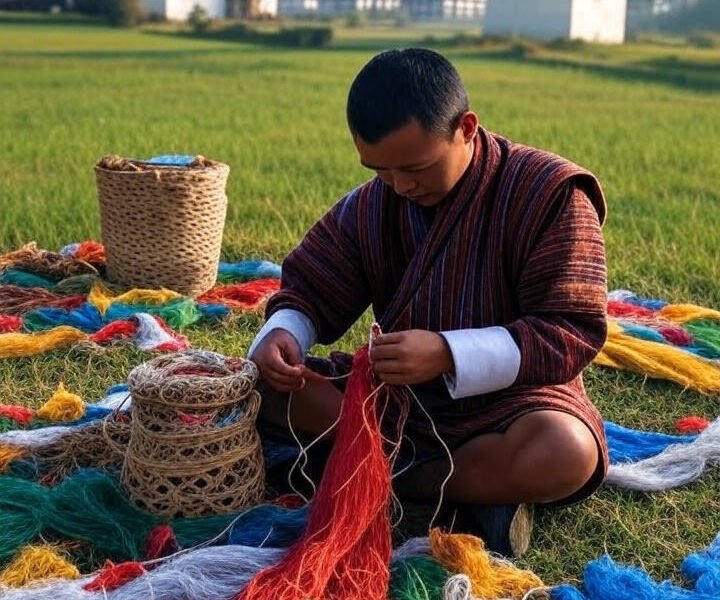
In Bumthang’s fields, farmers use bamboo baskets for everything from carrying apples to storing grain. These sturdy carriers, woven by hand, reflect resourcefulness. At home, recreate one using newspaper or old magazines, a nod to sustainability.
Roll 20 sheets of newspaper into tight tubes, securing with tape—aim for 1/2 inch diameter. Weave the base: lay 8 tubes in a star shape, crossing at centers, then weave another tube around them, alternating over and under. Add more for height, folding ends inward. For the rim, bend tops over and tuck in. Coat with varnish for durability. This small basket, 8 inches wide, takes three hours and uses free materials.
Bhutanese baskets often feature patterns from cane or willow, skills passed down families. Yours can hold fruits or keys, reducing plastic use. In Haa, I watched a weaver, Dechen, 50, craft one in under an hour—her speed from years of practice. Mine sits on my desk, holding pens, a practical piece with a story.
Painted Thangka-Inspired Wall Art: Spiritual Strokes
Thangkas, those intricate scroll paintings of deities, hang in Bhutan’s monasteries like Kurje Lhakhang. They’re meditative tools, detailed with gold and minerals. For a simplified version, paint a canvas with acrylics, focusing on a central figure like the wind horse.
Prep a 16×20 canvas with white primer. Sketch a horse in the middle, surrounded by flames or clouds. Use gold paint for outlines, blues and reds for body, adding jewels with dots. Layer colors for depth, letting dry between steps. Frame it or hang as is. This project spans four hours over two days, costing $15 for supplies.
Thangkas require months for masters, using natural pigments. Yours captures the essence—hang it for calm. In Jakar, artist Tenzin, 45, showed me his work, explaining symbols like the horse for luck. My piece adorns my living room, a focal point for reflection.
Handmade Incense Holder: Aromas of the East
Bhutanese incense, made from juniper and herbs, fills temples with soothing scents. Craft a holder from clay, shaped like a dzong fortress, to burn sticks safely.
Knead air-dry clay, rolling it into a 1/4 inch slab. Cut a base 4×6 inches, then walls 2 inches high, assembling like a box with a sloped roof. Poke holes for incense sticks, add details like windows with a toothpick. Dry for 24 hours, paint in white and red. This takes two hours active time, $8 for clay.
In Bhutan, incense purifies air and minds—monks in Punakha burn it daily. Your holder can use store-bought sticks, creating a serene corner. Mine sits on a shelf, its aroma reminding me of dzong courtyards.
Fabric Prayer Wheel: Portable Peace
Prayer wheels, spun for merit, line Bhutan’s paths. Make a small fabric one for your desk or bag, filled with mantras.
Cut felt into a cylinder 4 inches tall, 2 inches wide, sewing sides. Fill with printed mantras—Om Mani Padme Hum repeated—then seal. Add a wooden dowel through the center for spinning, decorating with beads. This quick craft, one hour and $5, brings calm.
Wheels in places like Chimi Lhakhang are massive, turned by pilgrims. Yours fits in a pocket, a twist for mindfulness. During my Trashiyangtse visit, I spun one at Gom Kora, feeling its rhythm. Now, mine accompanies me, a link to that peace.
These projects, inspired by Bhutan’s crafts, offer more than items—they connect to a culture valuing simplicity and spirit. Materials are accessible, steps forgiving for beginners. In a fast world, they slow us down, fostering creativity. If you try one, share your twist—perhaps adding personal symbols. Bhutan taught me making by hand heals the soul, a lesson these crafts carry forward.
(Word count: 1,248)