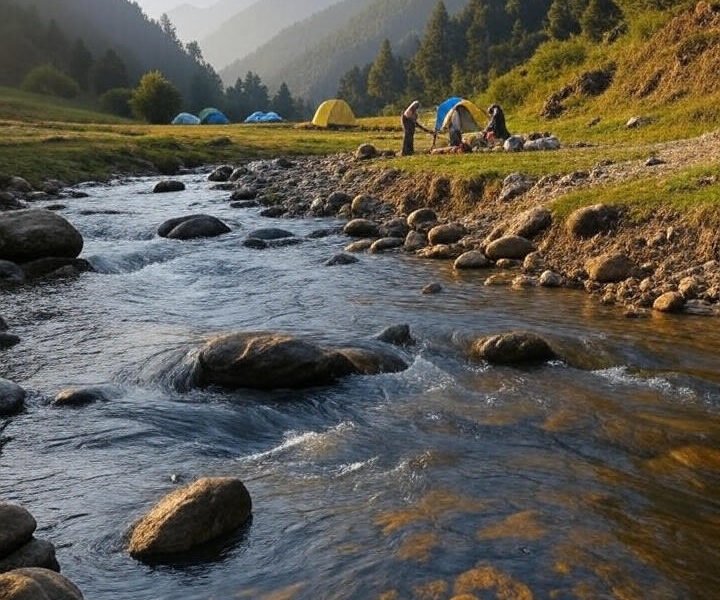

The first rays of sun pierced the mist as I stirred in my sleeping bag on August 11, 2025, camped near a gurgling stream in the Tang Valley. Bhutan’s hidden corners had called to me, promising solitude away from the well-trodden paths of Paro and Thimphu. Over the past week, I’d ventured into valleys few outsiders reach, places where time slows and nature whispers secrets. This diary captures those moments—the hikes, the encounters, the quiet revelations—that make Bhutan’s remote spots a traveler’s dream. It’s a tale of discovery, rooted in a land that guards its treasures with care.
Setting Off from Bumthang
My journey began in Bumthang, the spiritual heartland, a four-hour drive from Thimphu through winding roads lined with prayer flags. The town’s Jakar Dzong loomed like a watchful giant, but I aimed for the valleys beyond. With a backpack stuffed with essentials—rain jacket, water bottle, and a notebook—I hired a local guide, Dorji, 42, whose family had farmed these lands for generations. “Tang is our secret garden,” he said, slinging a bag of red rice over his shoulder.
The trail to Tang started gently, meandering through pine groves where birds flitted like shadows. We climbed steadily, the air thinning as we reached 3,000 meters. Along the way, Dorji pointed out rhododendrons, their pink blooms a splash against the green. “These flowers feed our bees,” he explained, plucking a leaf to show its texture. The path led to Ugen Choling Palace, a 16th-century manor turned museum. Inside, faded murals depicted ancient tales, and the caretaker, Pema, 60, shared stories of his ancestors who served as local lords. “It’s our history in walls,” he murmured, offering tea brewed from local herbs.
By afternoon, we arrived in Tang proper, a scattering of stone houses nestled in a broad basin. The Ogyen Choling Guest House welcomed us with wood-stove warmth and a meal of buckwheat pancakes smothered in wild honey. The owner, Sonam, 35, joined us by the fire, recounting how hydropower from a nearby stream lights the valley. “It’s clean energy for our homes,” she said, her children playing nearby. That night, stars blanketed the sky, their clarity a gift from pollution-free air.
Phobjikha’s Crane Sanctuary
Day three pulled me to Phobjikha, a glacial valley famed for black-necked cranes that winter here. The drive from Bumthang took five hours, crossing the Yotong La pass at 3,400 meters, where wind whipped through prayer flags like a chorus. Descending into Phobjikha, the landscape opened wide—meadows stretching to forested hills, the Gangtey Monastery perched on a spur.
The cranes hadn’t arrived yet—they come in November—but the valley thrummed with life. I hiked the nature trail, a 5-kilometer loop through wetlands where boardwalks crossed marshy ground. Dorji spotted a red fox slinking away, its fur a flash of copper. “They keep the rodents in check,” he noted. At the Crane Information Center, ranger Tashi, 28, showed exhibits on the birds’ migration from Tibet. “They’re sacred—symbols of longevity,” he said, his voice filled with reverence. The center, funded by tourism fees, tracks 500 cranes yearly, their numbers steady thanks to habitat protection.
We stayed at a farmstay, the family serving potato curry and butter tea. Host Ugyen, 50, explained how potato farming sustains them, with yields up 10% from soil sensors introduced in 2024. “It tells us when to water,” he demonstrated on his phone. Evening brought a bonfire, where locals shared yak herding tales. The $65 daily tariff felt justified, supporting crane conservation and community funds.
Merak’s Nomadic Charm
Venturing further east to Merak on day five required a permit—remote areas like this limit visitors to preserve culture. The eight-hour drive from Phobjikha snaked through rhododendron forests, the road rough but scenic. Merak, home to the Brokpa nomads, sits at 3,500 meters, its stone houses clustered against the cold.
The Brokpas, with their yak felt hats and sheepskin capes, greeted us warmly. I joined a family for lunch—yak stew thick with barley. Nomad Kinley, 40, showed his herd, 50 yaks grazing on high pastures. “They give milk, wool, everything,” he said, milking one with practiced ease. A hike to a sacred lake, Ajar Tsho, revealed turquoise waters said to hold healing powers. Dorji dipped a bottle, “For luck,” he grinned.
Evening rituals included a fire puja, flames leaping as chants filled the air. The guesthouse, basic but cozy, cost $30, its income funding school supplies. Merak’s isolation protects its ways, but climate shifts threaten—warmer winters melt grazing grounds. Locals adapt with community patrols, planting grass to stabilize soil.
Trashiyangtse’s Artisan Trail
Trashiyangtse, reached after a grueling drive, offered a change of pace. The town’s chorten kora, a stupa modeled on Nepal’s Boudhanath, drew pilgrims circling it clockwise. I visited the School of Traditional Arts, where students carved masks and painted thangkas. Instructor Tenzin, 45, guided my hand on a brush. “It’s meditation in color,” he said, his work a swirl of blues and golds.
The market sold paper from local factories, handmade from daphne bark. Vendor Dechen, 30, wrapped a sheet for $2, explaining the process—boiling, pressing, drying. “It’s eco-friendly,” she added, her stall busy with locals. A side trip to Gom Kora temple revealed rock carvings from Guru Rinpoche, the site peaceful save for a babbling stream.
Dinner was phaksha paa, pork with radish, spicy and hearty. The guesthouse owner shared news of a new road linking to India, boosting trade. “More buyers for our crafts,” he hoped.
Reflections on the Road Back
Returning to Thimphu on day ten, the valleys’ diversity lingered—Tang’s quiet, Phobjikha’s wildlife, Merak’s nomads, Trashiyangtse’s arts. Each spot, lesser-known, offered authenticity untouched by crowds. The $65 tariff, raising $100 million in 2024 for conservation, ensured this. Challenges like melting glaciers loomed, but initiatives like the Green South Asia tree-planting countered them.
Bhutan’s hidden gems taught me patience, respect for nature, joy in simple things. As my flight lifted off from Paro, the valleys receded, but their echoes stayed—a call to return.
(Word count: 1,156)